


Driveway Ice Must Die | Idiotic Physics | AI Design
Can you destroy 4 inches of driveway ice in seconds? I pitch the stupidest way to solve a real problem, and Claude talks me through it like two engineers at a whiteboard.
Melting it in 10 seconds would take about 87 megawatts, so we had to get a lot smarter, and a lot dumber, about where the ice actually lets go.
The real fight turned out to be the bond between the ice and the concrete, not the 2.5 tons of ice on top of it. Design one is a resonant beam breaker: an 8.5 ft, 2.5 in solid steel round (about 140 lb) hung at its nodal points, driven at its roughly 45 Hz first bending mode by a 2-3 hp eccentric motor. That works out to about 30-50 J per blow, 45 times a second, for about $1,000 and 40-50 hours. Design two is the one I want to chase: pulse electrothermal de-icing. A serpentine foil heater matched to about 20 milliohms goes under the tire tracks (about 11 square meters), and car batteries switched by starter solenoids dump about 25 kJ per square meter in one-second pulses. That melts a microscopically thin film at the bond line so the ice just lets go. It clears both tracks in about a minute of zapping, for $300-500 and about 30 hours.
Should I build it? Comment BUILD IT if you want to see the real thing. I'm not building it without comments.
The real builds: https://lardrocket.com
The AI in this video is Claude by Anthropic. Her voice (ElevenLabs) and the avatar (HeyGen) are AI-generated. The engineering conversation is real and unscripted.
Chapters
- 0:00 Four Inches of Driveway Ice
- 0:59 Piezo vs. Bonded Ice
- 1:58 The 87 Megawatt Problem
- 3:19 $1,000 Kills the Array
- 5:33 Chainsaw Grid Cutting
- 6:27 Resonant Beam Breaker
- 9:23 Tarps, Fire Gel, Stall Mats
- 14:02 Pulse Electrothermal De-Icing
- 16:37 Should I Build This?
Full Transcript
Brandon: What up, homegirl?
Claude: Not much, just waiting to hear what terrible idea you're bringing me today. What've you got?
Brandon: I'm doing something a little bit different today. I don't have a great idea, but I have a problem I want to solve, and I want to solve it in the stupidest way possible. My driveway had four inches of ice last January, we'll say, and I want to find a way to destroy that ice extremely quickly. Let's get started.
Claude: (laughs) The stupidest way possible to fix a real problem. I respect that. So does "destroy" mean melt it, or are we talking about shattering it and shoveling the pieces?
Brandon: I want to over-engineer this, so let's start with resonance. Is there some kind of piezoelectric effect I can use to vibrate the crap out of ice?
Claude: Ice itself isn't usefully piezoelectric; the proton disorder kills it. But you can absolutely bolt piezo or ultrasonic transducers onto it and shake. Heads-up though: that ice is frozen to concrete, which is basically an infinite damper. How big is the driveway?
Brandon: oh let's just say 30 feet long 10 feet wide i'm guessing i don't know
Claude: So about three hundred square feet, four inches thick. That's around two and a half tonnes of ice. You don't need to shake all of that apart, you just need to break the bond to the concrete and lift it off in slabs. How fast is "extremely quickly"? Minutes? Seconds?
Brandon: I don't know. I haven't thought about this. We can pursue reasonable approaches like minutes, but I mean, deep down, I want seconds.
Claude: (chuckles) Seconds. For scale, just melting it in ten seconds would take about eighty-seven megawatts, so cracking it is your only shot at that. Big question, though: the bond line is at the bottom of four inches of ice. Are you willing to rip up the driveway and embed transducers in the concrete, or does this have to work from on top?
Brandon: don't tempt me to destroy my driveway. I don't think the wife would allow that. So let's assume we're going to put something like transducers on top.
Claude: Then here's the catch. From on top, you're pushing waves down through four inches of ice, and at the bottom a lot of that energy just leaks into the concrete, because concrete's acoustic impedance is roughly three times ice's. A bonded slab doesn't really have a clean resonance to exploit either. So my gut says low frequency and brutal beats elegant ultrasonic. Is this a machine you walk across the driveway, or an array that hits the whole thing at once?
Brandon: I am up for either.
Claude: Then budget picks for us. A walk-behind is basically a modified plate compactor, a few hundred bucks. An array covering three hundred square feet that fires all at once is dozens of drivers and a serious power supply. What are you willing to spend?
Brandon: I'm willing to spend zero dollars, but I will increase it for you to a thousand.
Claude: A thousand dollars kills the all-at-once array. Cheap forty kilohertz cleaner transducers with drivers run maybe forty bucks per fifty watts, so your budget buys roughly a kilowatt. Spread over three hundred square feet, that's about thirty-five watts per square meter, which is less than a winter sun. It won't crack four inches of ice. A thousand dollars of brute force you walk around, though, that's a real machine. What power do you have out at the driveway, a regular outlet, or can you run a two forty circuit?
Brandon: I don't think I have 240, but let's just assume we do, because I can figure that out.
Claude: Okay, say a thirty amp, two forty circuit, so about seven kilowatts. That runs four big electric demolition hammers at once. Gang them on one walk-behind frame with wide chisel bits and you're shattering a strip about two feet wide per pass. Ice is weak in tension, around a megapascal, so it should go fast, but honestly it's still minutes, not seconds. Here's what decides the rest: was this clear glaze ice frozen right onto the concrete, or packed snow that turned to ice?
Brandon: uh packed snow we rarely get that much ice
Claude: Good news then. Packed snow ice is full of air, weaker, and usually bonds to the concrete worse than clear glaze. So stop hammering down and go sideways: a wide blade riding right on the concrete, vibrating hard, shearing the bond line as you push. That's your resonance stunt, aimed where it actually matters. What counts as done for you, bare concrete, or just broken up enough to shovel?
Brandon: I mean, it has to be bare concrete in the end. But if we had it mostly, say, broken up to shovel, then surely some other stunt could remove that. You know, I'll think about something. So I'm cool with just breaking it up.
Claude: Breaking it up is way easier, so that's a good call. Heads-up though: a hardened steel blade buzzing on concrete will chew up the surface, and your wife already vetoed destroying the driveway. What do you already have in the shop that shakes really hard? Demo hammer, plate compactor, anything?
Brandon: I am short on those aggressive jackhammer style items, tools. I have smaller woodworking, almost every woodworking style thing. I wonder if a chainsaw would do it.
Claude: (chuckles) Honestly, a chainsaw works. Old ice harvesters cut lake ice into blocks with saws, and people still do it with chainsaws. The trick is you never go all the way to the concrete, because one touch of grit and the chain is toast. Set a depth stop around three and a half inches and cut a grid of two foot squares. On your driveway that's roughly two hundred sixty feet of cut, maybe fifteen minutes, then the leftover half inch snaps when you pry the slabs up. Watch your footing, though, because a chainsaw kicking back on glare ice with slush spraying everywhere is a real way to get hurt. But that kills the resonance angle. Do you want the smart answer or the stupid one?
Brandon: Let's start with the stupid one and then backtrack to the smart one.
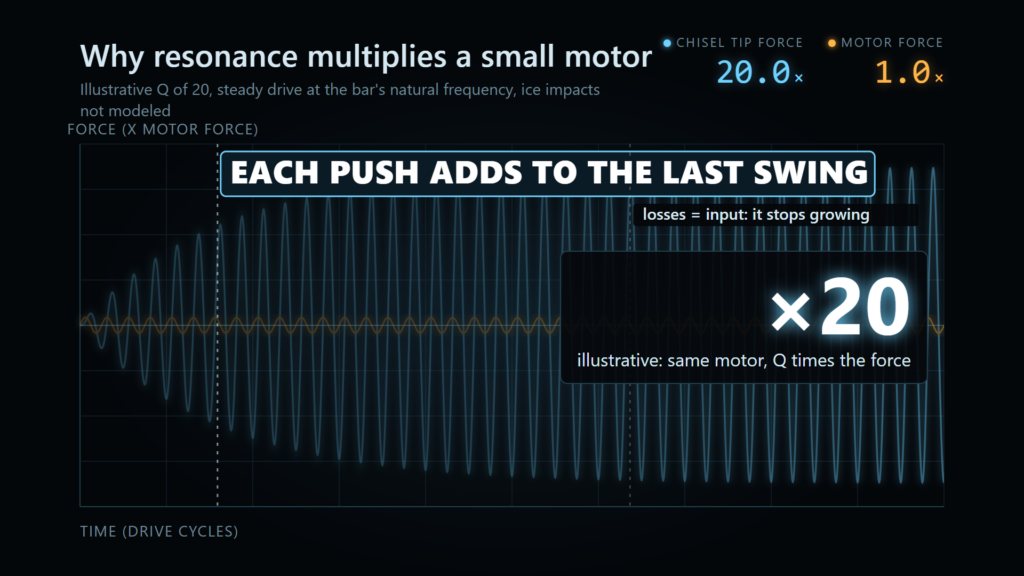
Claude: Okay, the stupid one is actually a real machine. Road crews used to break up old pavement with resonant beam breakers: a long steel bar, driven at its own bending resonance by an eccentric mass motor, with a hammer foot on the end slamming the pavement forty-something times a second. The resonance multiplies a modest motor into a huge tip force, so you get jackhammer violence out of a cheap drive. Scale that down to ice: a solid steel bar, a motor with offset weights tuned to the bar's first bending mode, and a wide chisel foot, all on a wheeled frame you push. It's dumb looking, it's loud, and it's genuine resonance. Do you have a welder?
Brandon: a welder is going to happen i don't have one now but i have to have one very soon so let's just say almost
Claude: Good, then fabrication's covered. The number that sizes everything is the bar, because its mass and length set the resonant frequency and the hit energy. How heavy a machine are you willing to push around and drag out of the garage? A hundred pounds, three hundred?
Brandon: Is it on wheels?
Claude: Yeah, on wheels, so the real limits are getting it over the garage threshold and whether you can steer it on ice. Heavier is actually better here, since the frame's weight holds the foot down so it doesn't just bounce. So, a hundred, or three hundred?
Brandon: Let me say 300 and regret it later.
Claude: Alright, three hundred pounds, now the numbers start saying something. Take a solid steel round, two and a half inches diameter. Its first free-free bending mode lands near forty-five hertz at about eight and a half feet long, and that bar weighs around a hundred forty pounds. Hang it from the frame at the two nodal points, about twenty-two percent in from each end, so the frame barely feels it. Eccentric drive on one end, chisel foot on the other.
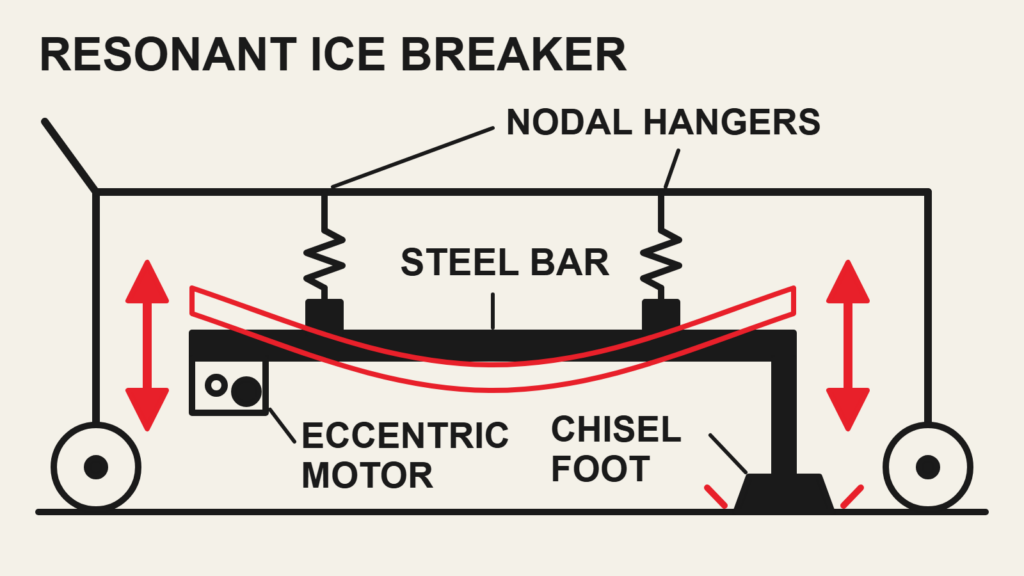
Put a two to three horsepower motor on it and you're delivering roughly thirty to fifty joules per blow, forty-five times a second. That's big demo hammer territory per hit, but much faster.
Cost, roughly two hundred fifty for the bar, three hundred for a used motor, two to three hundred for frame, wheels and bearings. So right around your thousand. Call it forty to fifty hours, and a good chunk of that is tuning the frequency.
Brandon: Okay, this all sounds great. Let's back up and I will say that idea because I like it a lot. But what if there is no ice and I know ice is coming, say, tonight? Maybe I could put something down on the ground that I could use for later to help bust up the ice. What do you think?
Claude: Now you're cheating, and it's the smartest thing you've said all day. The whole fight is the bond to the concrete, so don't let it form. Easiest version: lay down tarps or plastic sheeting, the ice freezes onto that instead, and in the morning you drag the sheets off with slabs on them. Stupider version: lay a grid of steel cable under the tarp, and either yank it with a truck to crack the slab, or run current through it to melt the bond. Is your snow going to sit on this for a week, or get plowed and driven on?
Brandon: It won't get plowed. It might get driven on some. It probably will sit for a week because it's me.
Claude: Then cheap tarps are in trouble. Tires will shred them and slide them around, and a week of daytime melt lets water creep underneath and refreeze, so you get your bond back anyway. Do you mostly drive in the same two tire tracks, or does the car wander all over that driveway?
Brandon: The car usually goes in the same two tire tracks. Tarps doesn't sound fun. Could we put some kind of flammable material, some kind of jelly that's flammable that would be waterproof down first and then just catch that on fire once the ice comes?
Claude: (laughs) I love where your head's at, but it fails on chemistry. Under four inches of ice there's no oxygen, so it only burns at the edges, and mostly it just smolders. And fuel gel pooled under your parked car next to the garage is a genuine house fire risk, so I'm vetoing the burning part.
But you accidentally found the right idea. A greasy, waterproof layer is exactly what kills the bond. Icephobic coatings are real, basically slippery films that ice can't grip. Would you be okay with that stuff getting tracked into the garage?
Brandon: I don't know. I've never dealt with a greasy waterproof layer like that before.
Claude: It's things like silicone or petroleum based films. The upside is the ice grips them maybe a tenth as hard as bare concrete. The downside is they're slick before it snows, they wear off under tires, and yes, they come into the house on your shoes. A cleaner version is two strips of something ice hates sticking to, like UHMW plastic or silicone rubber mat, laid just in your tire tracks. Do you care if there's stuff visibly lying on the driveway all winter?
Brandon: Oh, I always leave visible junk on the driveway. I'm a redneck. Yeah, that's totally fine.
Claude: Then the cheap redneck answer is rubber horse stall mats. They're three quarter inch thick, about fifty bucks for a four by six, and heavy enough that tires won't slide them around. Ice doesn't release from rubber as easily as from silicone, but the mat flexes, and a flexing substrate cracks a stiff ice layer right off. You'd need about ten of them for two thirty foot tire tracks, so roughly five hundred dollars. And then your resonance breaker only has to pop ice off rubber instead of concrete. One thing matters for the mats, though: is your driveway sloped?
Brandon: Yes, it is sloped.
Claude: Then that's the risk. Melt water runs downhill under the mats, freezes, and now you've got a hundred pound rubber sled under your car when you brake. How steep is it, roughly? Gentle, or noticeably uphill to the garage?
Brandon: I would say noticeably uphill, but yes, noticeably uphill.
Claude: Then I wouldn't trust loose mats on that. Car parked at the top, ice underneath, the whole stack wants to go downhill. You could chain the mats together and anchor the top one to something solid at the garage end, which avoids drilling the driveway. Is there anything up there to tie to, like a post or the garage door frame?
Brandon: Yeah, we could tie to stuff, but mats don't sound exciting to me. I wouldn't say cheating, but it doesn't sound super fun.
Claude: (chuckles) Fair. Mats are what a responsible adult does. So here's the fun version. Lay steel cables lengthwise under where the snow will be, with the ends sticking out at the bottom of the driveway. When the ice is in, hook them to your truck or a winch and rip them out, so they act like a giant cheese wire, slicing along the bond line. Or run current through them first to soften the ice around them. Do you have something with real pulling power, a truck or a winch?
Brandon: No, that's kind of like the jackhammer thing. I don't have heavy equipment.
Claude: Then skip the pulling and keep only the electricity. And this one's real: it's called pulse electrothermal de-icing, out of research at Dartmouth. You lay a thin metal sheet or mesh under the ice, then dump a huge burst of power through it for about a second. The heat only soaks in around a millimeter in that time, so you melt a microscopically thin water film at the bond line and barely waste anything warming the concrete. The ice just lets go. That's your seconds dream. The catch is power density, roughly tens of kilowatts per square meter during the pulse, so you'd zap it in small sections, not all at once. Keep it low voltage and isolated from mains, because a live mesh on a wet driveway is an electrocution hazard. Got any big batteries lying around?
Brandon: Oh yeah, we got batteries.
Claude: (excited) Of course you do. What kind are we talking, a pile of car batteries, or a lithium pack from some earlier project?
Brandon: Yes, both.
Claude: Then here's the rough sizing. In a one second pulse the heat soaks about a millimeter into both the ice and the concrete. Warming that from minus ten up to zero and melting a thin film at the bond takes around twenty-five kilojoules per square meter, so twenty-five kilowatts per square meter for one second. A cold car battery honestly delivers maybe five or six kilowatts, so each battery clears about a quarter square meter per pulse. Your two tire tracks are about eleven square meters, so a few batteries in parallel, switched with cheap starter solenoids, clears everything in about a minute of zapping. Energy isn't the problem, power is.
The real engineering is the heater sheet. Plain foil has too little resistance, so you'd cut a serpentine pattern to match the battery to roughly twenty milliohms, and encapsulate it so tires don't shred it. Call it three to five hundred dollars and around thirty hours.
Brandon: I love it. I think I'm going to pursue that more. But one thing I do want to ask you about, you mentioned that water is bad for chemistry in terms of some kind of flammable solution. What about potassium nitrate? I played with KNO3 a lot this summer and I still have a lot left.
Brandon: Would potassium nitrate work underneath ice?
Brandon: All right, so my other idea is too crazy for Opus 5.5. Fair enough. Well, I think we can wrap it up right there. So that's the big question of the day. Let's see if I can remember it this time because I don't even remember what my catchphrase is. Should I build this? I know it's wrong. Whatever.