

Laser Cut Pizza | Engineering Design | AI Lard Talk
Laser cutting a thick-crust pizza into a pi symbol with a 30 W blue diode laser.
The catch: pale mozzarella barely absorbs blue light, so the fix is a goth pizza with charcoal-black cheese and black dough.
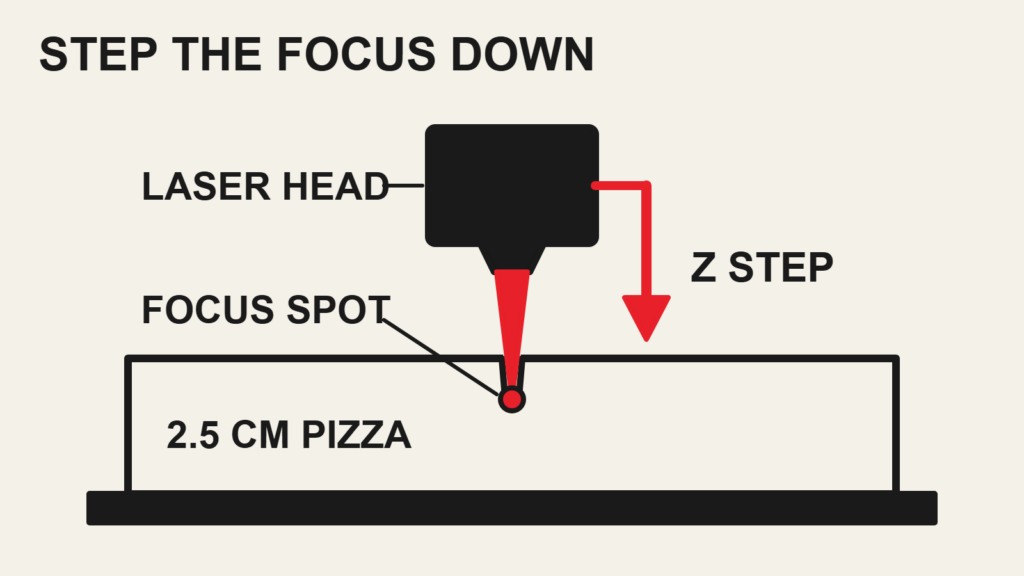
Where the design ended up: parbaked thick crust with black dough, cheese mixed with food-grade activated charcoal, finely crumbled sausage and pepperoni pressed flat, cut cold and reheated after. A 2.5 cm stack needs a Z-axis because a diode's focus is only a few mm deep, so it gets a motorized Z slide (or a lab jack under the pizza), air assist, and fume extraction. With everything black, about 18 W of a 30 W laser couples in, roughly 1 mm/s, so a 1 m pi outline takes about 25 minutes of beam time, call it 30 with Z-steps. If that 30 W is the electrical rating, real optical output is closer to 6 W and it becomes a 2-hour cut. Budget is about $200 (Z slide, air assist pump, charcoal, five test pizzas) and about 12 hours: 4 hours for the Z setup plus a day of dialing in power and passes.
Should I build it? Comment BUILD IT if you want to see the real thing. I'm not building it without comments.
The real builds: https://lardrocket.com
The AI in this video is Claude by Anthropic. Her voice (ElevenLabs) and the avatar (HeyGen) are AI-generated. The engineering conversation is real and unscripted.
Chapters
- 0:00 Laser Cutting a Pi Pizza
- 0:58 Raw Dough vs. Finished Pizza
- 2:24 Why Mozzarella Won't Cut
- 3:25 Hemoglobin and Black Cheese
- 4:13 Cut Time, Focus, Fire Risk
- 6:28 Adding a Z-Axis
- 9:15 Activated Charcoal Goth Pizza
- 10:01 Sausage Height Problem
- 10:52 Final Cut Time and Budget
Full Transcript
Brandon: Hello?
Claude: Hey Brandon, I'm here. What are we building?
Brandon: Um, I'm thinking that the pizza shape is boring and I need a new shape, maybe like a pie shape, as in like the math symbol pie. So I'm wondering if I can laser cut a pizza. What do you think?
Claude: (laughs) A pi-shaped pizza. (sarcastic) Because circles were just too obvious. Are you cutting the raw dough before it bakes, or the finished pizza with cheese and toppings on it?
Brandon: That is a great question. I imagine just taking a finished pizza and put it underneath the laser cutter, but maybe raw dough. I don't know. What do you think?
Claude: Gut call, raw dough. It's thin, uniform, and mostly water, so a CO2 laser just boils a clean kerf through it. A finished pizza is a two-centimeter stack of molten cheese and grease, which means flare-ups and smoke all over your optics. What laser do you actually have?
Brandon: I have a diode laser. I forgot the specs on it, but let's just say diode laser. Does that help?
Claude: It helps, and not in a good way. Blue diode light passes right through water, so pale dough mostly scatters it. You'd scorch the top instead of cutting through. How thick is the dough you're picturing?
Brandon: Well, I'm a thick crust kind of guy.
Claude: (chuckles) Of course you are. Then heads-up, thick dough rises in the oven, so your nice sharp pi legs puff into a blob. Is the laser the point of the stunt, or just getting a pi-shaped pizza?
Brandon: I'm not married to the pie shaped pie shape. That was what popped in my head originally. It could be the shape of an elephant or a race car or whatever. But the point is definitely the shape.
Claude: Then here's the thing. If the shape's the point, a sharp steel cutter or a knife beats any laser on thick dough. So does the laser HAVE to be in the shot, or is it just the tool you happen to own?
Brandon: The laser is a good tool for this.
Claude: Okay, your call. Then don't fight raw dough. Par-bake the crust plain, so it's dry and brown, and brown actually absorbs blue light. Laser the shape, then add sauce and cheese and finish it. Would you be okay toppings going on after the cut?
Brandon: It feels like cheating. Which toppings are the problem with the laser?
Claude: Cheese is the worst. Melted mozzarella is pale, wet, and fatty, so it reflects the beam, and the bit it does melt flows right back into your kerf. Sauce is mostly water, so it just boils and splatters. Pepperoni actually cuts fine since it's dark, but it renders grease. Grease plus a laser is a real fire hazard, so keep an extinguisher handy. Would you be cutting it hot, or cold out of the fridge?
Brandon: well hang on first i want to push back on the the melted mozzarella thing you said that pale wet and fatty um makes it safe for later should say safe but it makes it uh it won't cut through a laser but i am pale wet and fatty and lasers cut me right
Claude: (laughs) Fair. But you've got blood in you. Hemoglobin absorbs blue light like crazy, and that's exactly why a diode burns skin so fast. Mozzarella has no hemoglobin. It WILL eventually scorch and brown, then absorb better. You'll just get a burnt, melty trench instead of a clean cut. So, hot or cold?
Brandon: Can we put blood inside pizza cheese?
Claude: (laughs harder) Blood pudding is a real food, so technically, yes. But what you really want is just something dark that absorbs blue light. Black or dark blue food coloring in the cheese would do the same job. Would you eat black cheese?
Brandon: Oh, hell yeah I would.
Claude: (chuckles) Okay, black cheese it is. Now I really need that laser's power. Can you check the label for the optical output in watts? A five-watt and a twenty-watt diode are completely different stunts here.
Brandon: Let's assume 30 watts for the sake of brevity.
Claude: Thirty watts, nice. Rough numbers. Say the whole stack is two and a half centimeters thick, with a kerf about a third of a millimeter wide. Every millimeter of cut means boiling off about seven milligrams of mostly water, roughly twenty joules. If a third of your beam actually couples in, you're moving about half a millimeter per second. A pi outline on a big pizza is a meter or so of perimeter, so call it forty-five minutes of cutting.
The bigger problem is depth of focus. A diode's focus is only a few millimeters deep, so you can't punch through two and a half centimeters in one pass. You'd be stepping Z down, pass after pass, while the kerf walls char.
So it'll be under the laser for most of an hour. Are you okay eating it cold?
Brandon: So right now we have two problems, it seems like. We have the focus, so we need Z-axis adjustment, which I don't currently have, but I would build that for this. It'd be worth it, I think. But then we also have the cold pizza problem. Oh, we have another problem, too, is the fire that could happen from the grease. So it sounds like we need a vacuum, we need a way to alter the Z-axis, and we also need a way to keep the pizza warm.
Claude: That's the list, with one tweak. You want air assist right at the nozzle plus fume extraction, not just a vacuum. Air assist blows the molten stuff out of the kerf and keeps flare-ups from catching. And a heads-up on keeping it warm: warm cheese is runny cheese, and runny cheese flows right back into your cut. Honestly, cutting it cold and then reheating it might be the cleaner path. Does a reheat count as cheating to you?
Brandon: Hmm, definitely doesn't feel honest, but maybe we need to lie this time.
Claude: (chuckles) A little white lie, all in the name of crisp edges. Okay, Z-axis next. Is your laser an open-frame gantry, where you could raise the whole head on a lead screw, or would you rather move the bed?
Brandon: The laser is open frame. I think lifting the Z shouldn't be an enormous project.
Claude: Agreed, it's small. Thirty millimeters of travel, a little stepper, a lead screw, and a linear rail is maybe fifty bucks and an afternoon. The catch is the controller. A lot of diode laser boards only have two stepper drivers. Does yours have a spare Z output?
Brandon: It actually might. I would have to look. If it didn't, I bet we could tap off serial out from that board or some other protocol, I squared C or something like that.
Claude: You could, but there's an easier way out. Z only moves between passes, not during the cut, so it doesn't need to be synchronized. A cheap three-axis GRBL board is about thirty bucks, or honestly, a pause at the end of each pass and a hand crank works fine. Would you be okay babysitting it with a crank?
Brandon: How would I make sure I got the focus correct when I cranked it?
Claude: Count turns. With a two-millimeter-pitch lead screw, one full turn drops the focus exactly two millimeters. Put a detent or a printed dial on the crank and you just click down one notch per pass. Set your first focus on the top of the cheese with your normal focus gauge, then everything after that is just counting.
Brandon: We need to stay electrical here one way or another because my laser is big. It's like one meter by one meter, roughly. So I'd probably need a stepper in all four corners to make that work. But that's easy. I could just push a button and the microcontroller would just lower the bed evenly in all four corners.
Claude: Hang on, why move the bed at all? Lifting a meter-square bed on four steppers means keeping four corners perfectly in sync, and if one skips a step, your bed racks. The laser head weighs maybe a pound. One little stepper on the head does the same job. What's stopping you from moving the head?
Brandon: The mechanical situation of that… There's no current Z adjustment. I'd have to really figure that out. That might get tricky.
Claude: Two easier options. They sell bolt-on motorized Z slides for diode modules, around fifty bucks, that mount between your carriage and the laser. Or remember, the pizza is only about forty centimeters across. You don't need to lift a one-meter bed, just a small platform under the pizza, like a motorized lab jack. Which sounds more like you?
Brandon: I'm cool with either one of those. I'm not too worried about the Z axis stuff. I can handle that. How do I make sure the cheese is black?
Claude: Use food-grade activated charcoal, also sold as vegetable carbon. It's a true broadband black, so it soaks up blue light almost perfectly, and it doesn't fade in the oven like dye blends can. Toss it with the shredded cheese before it bakes so it's black all the way through, not just on top. Heads-up, charcoal can block medications from absorbing, so don't go crazy with it. And remember, the inside of a thick crust is pale too. Are you willing to make the dough black as well?
Brandon: Willing. I'm definitely doing that, like, on all pizza, not just for this.
Claude: (laughs) Goth pizza, the lifestyle. Good news on the sauce, by the way. Tomato sauce is red because it absorbs blue, so it'll couple fine. That leaves toppings. What's going on this thing besides black cheese?
Brandon: Let's pretend I'm a real man eating pepperoni and sausage.
Claude: (chuckles) A real man with a black pizza. Both meats absorb fine, they're dark and red. The problems are grease and height. Sausage chunks stick up, so your cut path has lumps that are a centimeter taller than everywhere else. Is the sausage crumbled or sliced?
Brandon: I think we're going to have to go with crumbled, right?
Claude: Yeah, crumbled, and crumble it fine. Small bits sit flatter, so your stack height stays even and your Z steps stay honest. Press it down a little before the cheese goes on. Want me to rerun the cut time now that everything's black?
Brandon: Sure, please.
Claude: Black everything roughly doubles your coupling. Say sixty percent of thirty watts actually goes into the pizza, about eighteen watts. At around twenty joules per millimeter, that's nearly a millimeter per second, so the meter-long pi outline takes about twenty-five minutes of beam time. Add Z steps and some passes wasted on charred walls, call it half an hour. One caution: if that thirty watts is the electrical rating on the box, real optical output is more like six, and you're back to a two-hour cut.
Budget wise, fifty bucks for a Z slide, forty for an air assist pump if you don't have one, fifteen for charcoal, and maybe five test pizzas. Call it two hundred dollars. Time is about four hours for the Z setup and a day of dialing in power and passes. So it works, just slowly.
Brandon: So it sounds like a $200 pizza can be cut with a laser. All right, so that's the big question, boys and girls. Should I build this?